Palmanova: From Venice to Napoleon and today
Palmanova – the unique star-shaped fortress city in Friuli-Venezia Giulia – is not only an architectural masterpiece, but a living monument of military history.
A city whose history you can now experience on your own, whenever you want. Since 2017, it has held the title of UNESCO World Heritage Site as part of the "Venetian Defence System between the 16th and 17th centuries".
How Palmanova came to be
The history of Palmanova begins on October 7, 1593, when the Republic of Venice created a city from nothing – not just any city, but an ideal military city, perfectly planned and built according to the most modern fortress principles of its time.
The experienced fortress engineer Giulio Savorgnan was responsible for the concept, supported by the architect and mathematician Vincenzo Scamozzi . They designed a settlement that was not only intended to be impregnable, but also to embody the ideal image of a Renaissance city : symmetrical, orderly and clearly structured.
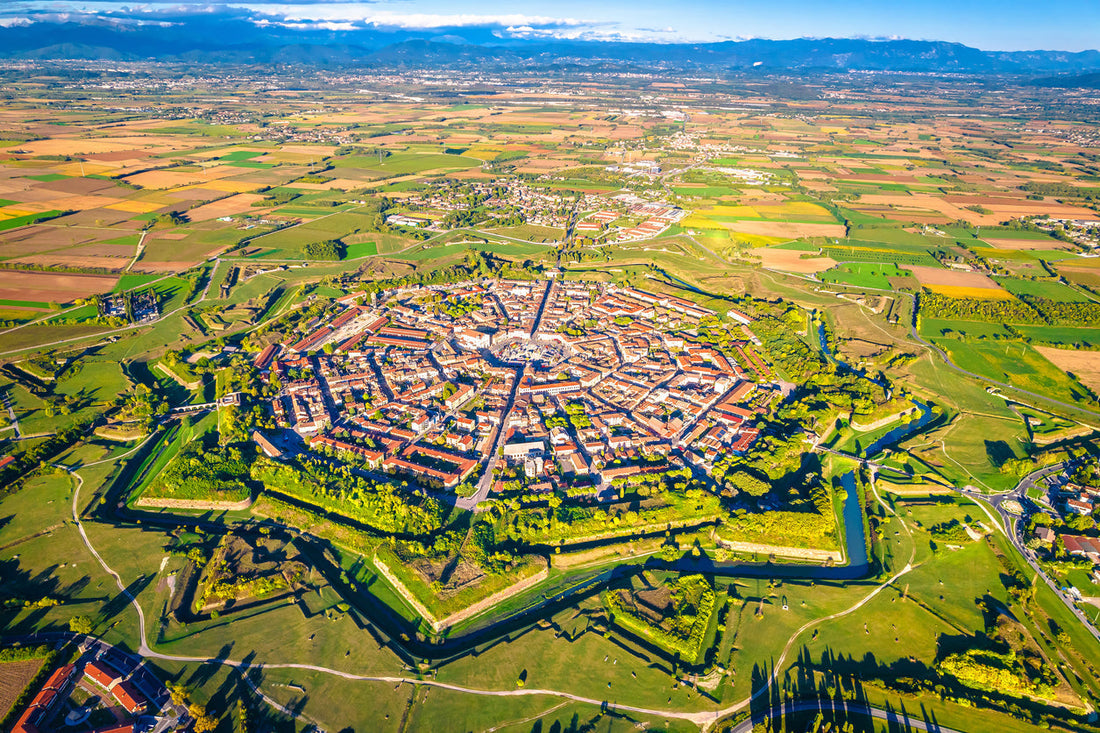
Viewed from above, Palmanova resembles a giant, nine-pointed star. Each bastion bears the name of a Venetian dignitary, and three imposing city gates – Porta Udine, Porta Cividale, and Porta Aquileia – lead into the city. All streets converge in straight lines on the Piazza Grande, the vast heart of the city, which served as both a parade ground and a control center.

This geometry was not just an aesthetic statement, but a tool: those who lived or served here could not escape the omnipresent order – every movement was planned and within sight.
In the following centuries, Palmanova changed hands several times. After almost 200 years under Venice, it fell to the Habsburg Monarchy in 1797, before Napoleon incorporated the fortress into his Kingdom of Italy in 1805 and reinforced it with additional outworks such as lunettes. After the Congress of Vienna, the Habsburgs returned, until Palmanova became part of the Kingdom of Italy in 1866 during the Third Italian War of Independence.
Palmanova remained a strategic military base well into the 20th century. During the First World War, it served as a logistics and medical center, and during the Second World War, it was again used for military purposes – this time by the fascist troops of Italy. The city was only spared complete destruction thanks to the intervention of courageous citizens.
Today, Palmanova is no longer defined by cannons, but by culture. In 2017, it received UNESCO recognition as part of the "Venetian defensive works between the 16th and 17th centuries." What once began as a strict utopia is now a place where visitors from all over the world can stroll amidst geometry, history, and the charm of an extraordinary city.
Your self-guided city tour as a scavenger hunt – experience Palmanova
Instead of just watching, you will become explorers:
- Flexible start: Anytime and without appointments via smartphone.
- Interactive route: You will be guided to exciting places – bastions, city gates, loggias.
- Enigmatic: Only those who pay attention will find the hidden details that many overlook.
- Reward system activated: Every puzzle triggers a small dopamine release in your brain – motivation and joy included.
Details & Practical Information
- Duration & distance: Approx. 1.5–2 hours, about 3 km on foot.
- Languages: German, English, Italian, Spanish, French.
- Price: €9.90 per person – book instantly at ixpirity.com . Use code TEAM for a 10% discount when buying 2 or more tickets.
- Suitable for: Families, couples, groups of friends and solo adventurers
Tip for your visit
- Palmanova's proximity to Udine (20 km) , Gorizia (28 km) and Trieste (55 km) makes it perfect for day trips.
- Complete your tour with the 7 km walking trail on the ramparts for magnificent panoramic views.
FAQ – Frequently Asked Questions about Palmanova & the Scavenger Hunt
1. When was Palmanova founded?
Designated by the Republic of Venice on October 7, 1593, as an ideal fortress city
2. Who designed the city?
Giulio Savorgnan (Ufficio Fortificazioni) and Vincenzo Scamozzi, supported by Marc'Antonio Barbaro
3. What makes the floor plan unique?
A nine-pointed star, three rings of walls, and rigid geometry for military and social control
4. Why was the city difficult to settle?
Initially, tax incentives and pardons were necessary – even for criminals – to attract residents.
5. Which countries historically ruled Palmanova?
Venice (1593–1797), Austria (1797–1805), Napoleonic Italy (1805–1813), Austria again (1815–1866), Italy since 1866
6. Since when has Palmanova been a UNESCO World Heritage Site?
Since 2017 as part of the Venetian fortifications
7. What can I expect from the scavenger hunt?
A self-guided city tour with puzzles, historical highlights and a motivating reward system